Sunday afternoons with James
...and how an hour of James Joyce, once a week, has made me fall in love with him all over again...

When I was in my first year of undergraduate work at Laurentian University, I took a British Lit survey course. It was 1989-90 and I was eighteen at the time of beginning first year. My major was English Literature and my minor was History. A fine balance. It was the first time I read James Joyce, and I remember that we read two stories from Dubliners. The stories were, of course, “Araby” and “The Dead,” both of which are dear to me still. Funny how you can read something in your earlier years and it stays with you, as a past love or memory. In both stories, I can sink in—thirty-five some odd years later—and feel the essence of Joyce’s Dublin. But, the way I read them now, with all of those years of life experience stretched between the readings, is with different eyes. How could it not be so? The same thing happens when I read Shelley’s Frankenstein, or Bronte’s Jane Eyre, or Austen’s Pride and Prejudice each year. I re-read to re-examine craft, but also because they are my favourite classics.
Feeling stuck in your body or house because of chronic pain can be hard, to say the least. I’m lucky I’m a writer, and that I love to read. Problem is that it’s hard to write (or read) when you’re feeling like shite and on what feels like a million meds. I read in small bits now, and I write in small bits, too. For now, the words I read and write are like tiny flutterboards that keep me from sinking. Day by day, a friend tells me, and I nod. Day by day. Chapter (or half chapter) by chapter. Paragraph by paragraph. Line by line. Someone else I’ve just been introduced to virtually by a mutual friend says that it’s best not to think ahead of the current day, just because waiting can be a long thing, with an indeterminate surgical date at the end. It’s all the mindfulness stuff of Rumi, Oprah, Chopra, Tolle. Fine in theory, yes, but harder in practice.
Some of my dearest and closest friends are writers who are far away from me geographically—in Victoria and Vancouver, on Bowen Island, in Regina, in Winnipeg, in Kitchener-Waterloo, in Ottawa, in Windsor, in Hamilton, in Toronto, in Kingston, in St. John’s, in Fredericton, and along the shores of Nova Scotia (both sides now). They keep in touch and know more about my life than some people here in Sudbury do, which is okay with me. Privacy is important to me. So much (too much) is shared by people on social media and private has blended precariously with public spheres. It’s a strange time to be alive as everyone seems to want to document their lives as if they’re in the movies. I wonder what James Joyce would write about now if he were around…and I also wonder what Norah Barnacle would think!
When I worked on writing my first year essay on “The Dead” all those years ago, I remember loving the way he described Dublin. At that point in my life, I hadn’t even visited Ireland, so I first discovered Dublin through the work of Joyce, Yeats, and Kavanagh. I was fascinated by Gretta Conroy and Michael Furey’s relationship, too, and wondered how a love can be so great that it can extend beyond physical death. Those beautifully written last lines of the story will always resonate with me:
“Yes, the newspapers were right: snow was general all over Ireland. It was falling softly upon the Bog of Allen and, further westwards, softly falling into the dark mutinous Shannon waves. It was falling too upon every part of the lonely churchyard where Michael Furey lay buried. It lay thickly drifted on the crooked crosses and headstones, on the spears of the little gate, on the barren thorns. His soul swooned slowly as he heard the snow falling faintly through the universe and faintly falling, like the descent of their last end, upon all the living and the dead.”
It’s a painting in my mind, and always has been. It’s cinematic and poetic. It’s perfection. Fight me. I would happily die on that hill.
The 1987 film version of the story, with Anjelica Huston (as Gretta Conroy) and Donal McCann (as Gabriel Conroy), is visually stunning and evocative. Books don’t usually translate well into films, as most writers will tell you, but this one did. Michael Furey is there, too, in the story and the film, an absence made present in Gretta’s (and Gabriel’s) heart. Michael Furey has always felt as real to me as Gretta, Gabriel, Lily, and the ‘Three Graces.’
In Spring 1990, I think, I won first place in the essay writing contest for my essay on “The Dead,” and my name’s on a plaque somewhere in some English office. I remember being so proud of receiving a letter from the head of the department, so excited to know that the clarity of my words could ring out to other people. Joyce inspired me and I wrote about his story with great admiration. How could I learn to write like that?? That’s what I wanted to know. I still do.
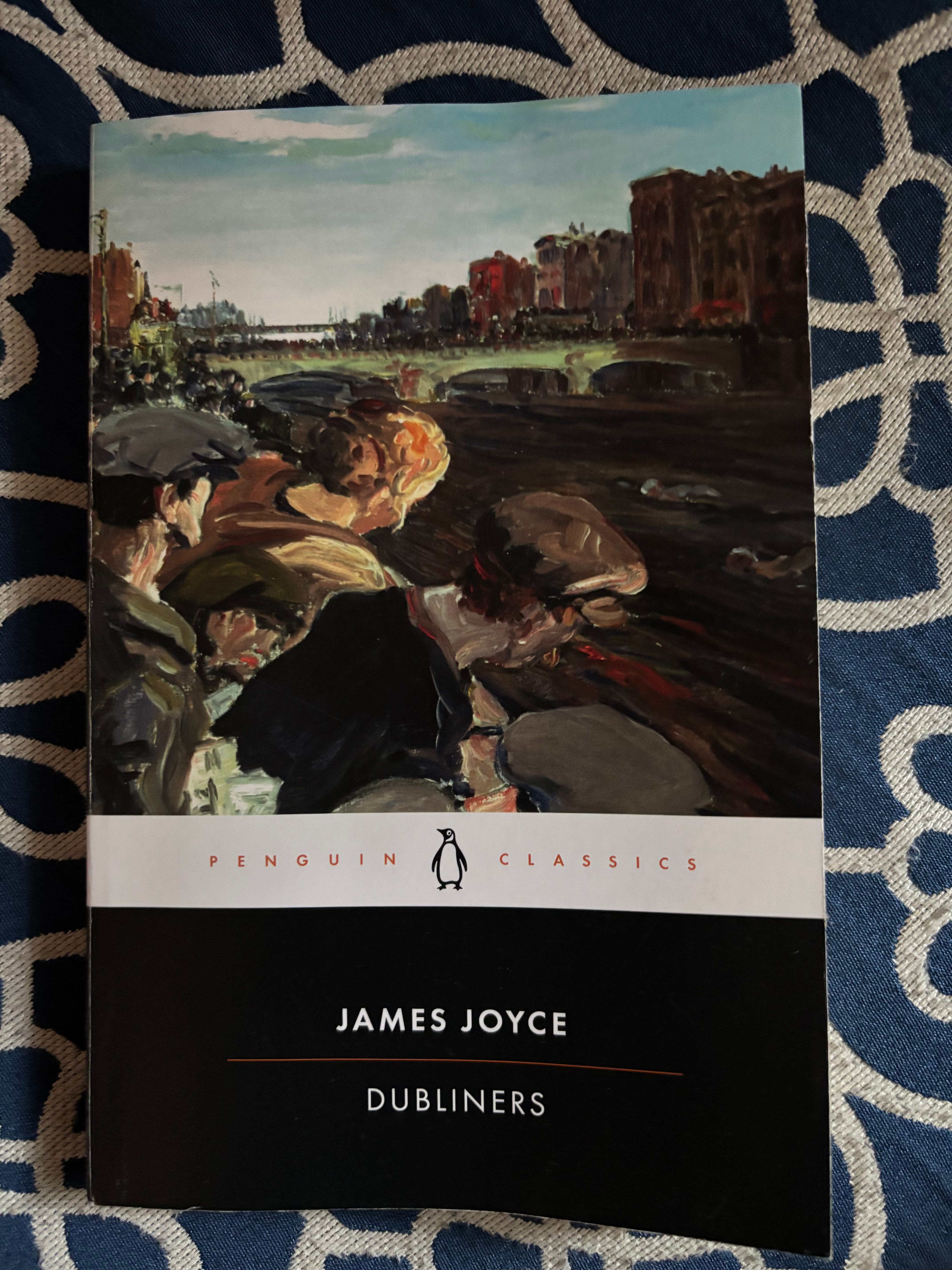
A while back, a dear friend invited me to join a Sunday afternoon reading group. They’ve made it through a number of Joyce’s works in the last few years, and now they’re reading Dubliners. It’s a lovely group that meets via Zoom every Sunday at 1pm (EST), and most are from Winnipeg. They are writers and scholars, and a quick, witty and kind group of souls. My first afternoon was sometime in February, and I found myself falling in love with James Joyce’s writing all over again.
When people grumble about Zoom, I shake my head. When you are needing writerly community, it’s more easily accessible through the internet for some of us. I think about this a lot lately. I want to be sure we think more about accessibility in Can Lit circles for disabled writers. That means physically accessible events, yes, but it also means online events organized by the various literary organizations across Canada. It means events that are free, too, for those who can’t afford to travel or take time off work. It means creating community in a mindful, focused way. Sometimes, it’s an invitation to taking part in a group, or a Zoom chat with another far away writer friend. This country is a such a vast space, geographically, and I think we need to remember that we’re not all centralized, but we can still be connected.
What I find in my Sunday afternoon reading group, while people take turns reading through the stories of Dubliners out loud, and then discussing them, is community and colleagiality. I’ve found new acquaintances, writers and scholars, and I’ve loved listening to Joyce read aloud. The hour goes by quickly, listening to the words come to me across great distances. I think of Joyce’s vast and colourful vocabulary, his turn of phrase, his references to how he struggled with Catholicism, with alcoholism, with women, and with just being different from others around him. He was frustrated by Ireland, but loved it still, even though he left it when he was young. He kept writing about it, though, and that’s what’s fascinating to me. But, Joyce was writing about a time that was rife with the frisson of conflict and picking sides—whether religious or political.
As we read, I flip back to end notes in my edition of the book to references of what’s what when Joyce refers to an outdated Irish custom or a Gaelic word I don’t recognize, and I shake my head at the idea that a word or idea has almost disappeared from the English language now. But it’s still there, it’s still here, in the fabric of his writing.
I often find myself thinking of how he portrays women. That part is more problematic for me, as a feminist, but I put on the lens of historical context while I listen and know that his writing about male and female relationships reflects the way it was at that time in Ireland, and in Dublin in particular. Still, the women I’ve noticed in his stories are quickly wedded, bedded, and bearing a number of children at young ages. Typical of the time. They have agency in their homes, but not always in their marriages. The men, well, the men drink after work in pubs, flatter and flirt with other women, and stumble home late. They aren’t of stellar stock. They’re self-involved. The brunt of the responsibility to keep home and children operating smoothly rests with the women. I think of how this is not far from what it is now, sadly. Often, Joyce’s women hope to marry for love and financial security, while the men marry for social appearance and status, but it’s the men who have the agency and freedom to flirt, visit brothels to cheat, make irrational decisions that affect their families, and then the wives pick up the rest of the pieces. So much to say about this…but enough for now.
Every Sunday afternoon, I listen to James Joyce’s work being read, and I feel like a little kid, being read to before bed. I lean into the laptop screen, let my eyes move glassily across the lines of text, flip to the back of the book for the scholarly references I don’t get, and (while I’m muted) make under-my-breath comments about how Joyce is a moron and a misogynist in some places. Still, I admire his facility with language, with capturing a time and place, with making Dublin into the living character I know.
When I have visited Dublin—about five times in my life now—I always get up at dawn and walk through the streets. I head to Merrion Square and circle it, minding my feet on the stones and curb, and admiring the painted doors and their bootscrapers, but always looking for specific addresses that are in Joyce’s works, or for historic houses that belonged to writers I have studied and admire. I let my hand drift along the black fence and imagine I’m back there, when Joyce, Yeats, and Kavanagh were writing. I make my way to the Grand Canal, find Kavanagh’s statue, sit next to it, and rub his knee for good luck. (I know there are other statues—of Yeats, of Joyce, and others—in Dublin, but Kavanagh’s is cool because of the bench!)
I say thank you to him, and the others, for their words, and then I watch a swan, or an early morning runner, pass by. This is my Dublin at dawn, the one Joyce first introduced me to in his stories, and the one I have come to love walking through in person. It’s quiet then, in the early mornings, and I can pretend I’m inside a story, or a poem; I can transport myself back in time, and then forwards again, using language and story to carry me through places and spaces. While I listen to the stories every Sunday afternoon, I can forget that I’m stiff and uncomfortable for an hour, and that’s a relief…
Thanks to Tanis for inviting me, and to the group for gathering me in. You’ve reminded me again of why literary community is a gift, and the discussions about Joyce each week fill me with questions I ponder and go on quests to answer in my head. Grateful, as always, for the pandemic chaos that brought us Zoom—and, for me, many more warm and welcoming literary friends across the country.
k.
A fine essay, Kim. I re-read Joyce's Ulysses every few years, always finding new pleasures in it. By the way, you should promote yourself: your bio note on here says you're "the first vice-chair" of TWUC. Now you're our fearless leader.
Oh, that James. 😀